
If water is getting in, start inside: catch the drip, move what matters, and photograph the stain. Then make one call. For roof repair in Lazy Lake, One Call Home Pros matches you with a vetted, licensed, insured local roofing professional who traces the leak and fixes it. One Call does not hold a roofing licence and does not climb your roof. We arrange the visit, vet the roofer and stay with the job until it is done.

Why Lazy Lake homes need roof repair handled with care
Lazy Lake is the smallest municipality in Broward County. It is a village of roughly two dozen homes, private, and in practice a single residential street, with Wilton Manors wrapped around it on every side. There is no other neighbourhood inside the village to absorb a roofing job. When a roofer works here, the truck, the ladder, the materials and the debris all sit on the one street every neighbour uses to get home.
That shapes how a repair should be planned. The weather is the same as anywhere in central Broward: hard summer sun, heavy afternoon storms and the hurricane season that tests every roof edge and tile. What is different is scale and access. A good roofing visit here is one that finds the leak, fixes it properly and leaves the street as it was found. One Call passes on the details that make that possible before the pro sets out.
What a roofer handles on a Lazy Lake house
Leaks during rain
A drip or a spreading stain that shows up with a storm. The roofer follows the water back to where it enters, which is rarely straight above the mark.
Broken and slipped tile
Concrete or clay tile that has cracked, slid out of line or come off, leaving the underlayment open to the sun.
Shingles lifted by wind
Tabs that a gust has folded back or torn, and older shingles worn smooth and brittle.
Flashing and vent boots
Metal flashing at walls and valleys, and the rubber collars round plumbing vents that split as they age.
The roof edge
Soft fascia boards and loose soffit panels, where rainwater and animals find a way into the eaves.
Storm records
Dated photos and a written description of wind damage, for you to pass to your insurer.
Before the roofer comes
You can do a lot from the floor without going near a ladder. Walk the house the day after rain and look up. Check every ceiling, including the ones people forget: the inside of closets, above the water heater, the corners of the garage, the porch ceiling. Look at the tops of walls for streaks or bubbling paint. If you have an attic hatch and can look in safely from the top of a step stool, a torch will show damp wood, stained insulation or daylight where there should be none.
Make a short note of what you find:
- Which room, and where in the room the water shows.
- Whether it appears with every rain, or only when the wind is strong.
- Whether you know the roof type: tile, shingle, flat, or a mix.
- Anything that changed recently, such as a storm, a satellite dish or solar panels added, or work on the gutters.
Those notes go straight to the roofer when One Call makes the match. They save time on site and help the pro bring the right materials first time.
One street, one way in
On most Broward streets, a roofer can park where it suits and spread out. In a village that is effectively one street, a little planning keeps the job from getting in anyone’s way. When you call, tell One Call:
- How the pro gets in. The street is private. If there is a gate, a code or a person who needs to open up, say so, or arrange to meet the roofer at the entrance.
- Where a truck can stand. Your driveway may be the only sensible place. If it is, move your own cars out of the way the evening before.
- Where material can go. Tile, bundles of shingles and a small debris bin need a spot that does not block a neighbour’s drive.
- Who is home. The roofer may need to see the stain inside before going up. Give the name of whoever will be there.
It is also a courtesy to tell the neighbours either side that work is coming. A roofing job is noisy for a short spell, and on a quiet street people notice a ladder going up.
Why the stain is not under the hole
Water on a roof rarely drops straight down. It gets in at one point, travels along the underlayment or down a rafter, and appears somewhere else entirely. A damaged tile near the ridge can show as a stain over a doorway on the far side of the room. A failed boot around a bathroom vent can soak insulation and drip into the hallway instead.
That is why a roofer starts inside, looks at where the water shows, then goes up and works back along the slope above it. It is also why patching the ceiling first is a mistake: the stain is the evidence. Leave it until the roof is fixed, then let it dry before anyone repaints.
Tile roofs and what fails beneath them
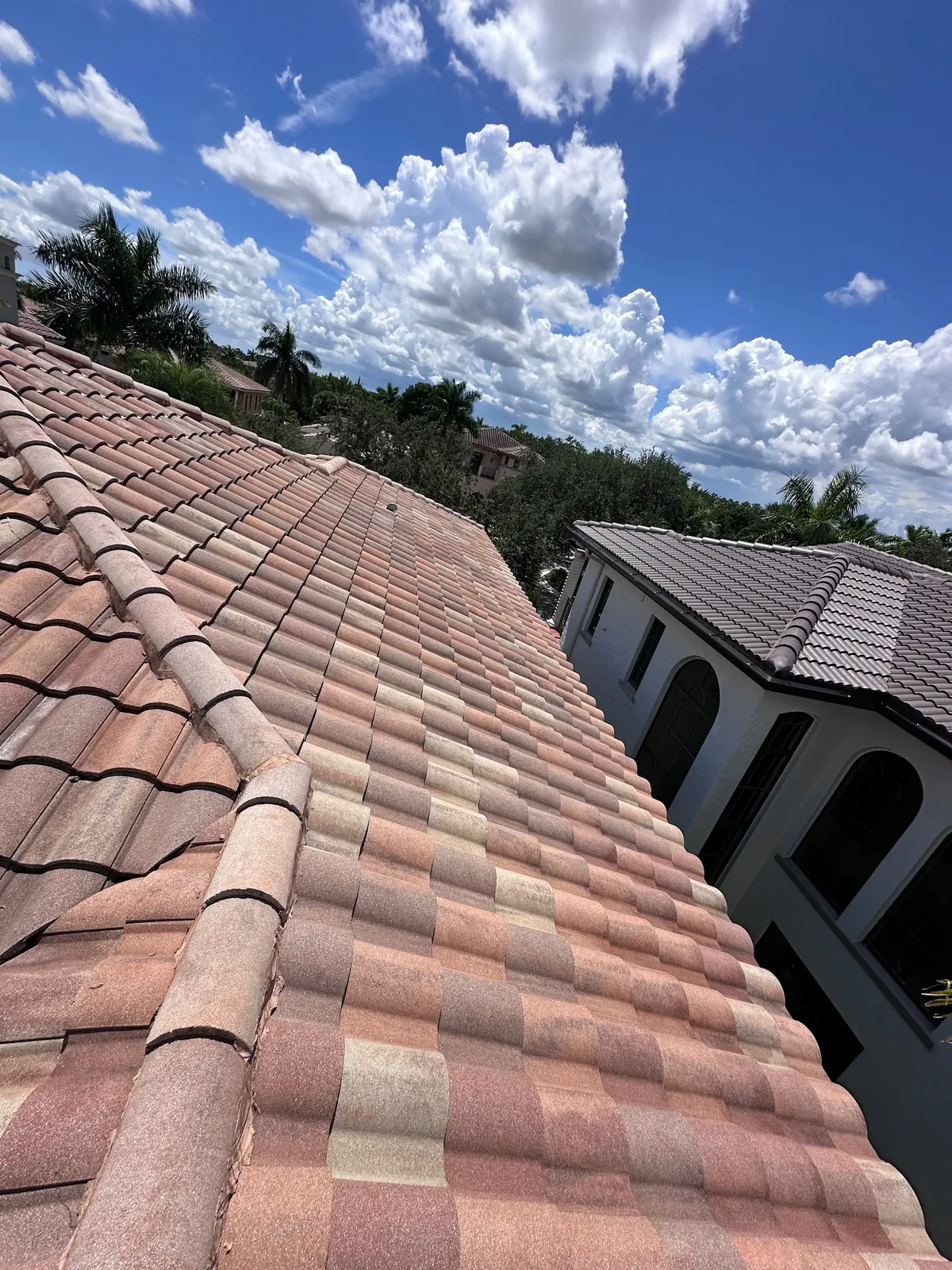
Concrete and clay tile is common across this part of the county. The tile is the outer shell. It sheds most of the water and shades the roof, but it is not the waterproof layer. The underlayment beneath it is. A tile can crack from a dropped branch, a foot in the wrong place, or simply sun and age, and when it does, water and ultraviolet light start working on the underlayment.
A tile repair usually means:
- Lifting the broken tiles and the ones around them.
- Checking the underlayment and the deck in that area for damage.
- Replacing what has failed underneath before new tile goes on.
- Fastening the new tile to the standard Broward’s wind rules require.
Matching older tile can take time. Colours fade and some profiles are no longer made. If your roof is an older tile, ask the roofer how close a match they can find and whether spare tiles you may have kept in the garage can be used.
Shingles, sun and wind
Asphalt shingles are held down by nails and by a seal strip that bonds each tab to the one below. Heat bakes that strip over the years, and a strong gust then lifts the tab, creases it and sometimes tears it away. Granules wash off the surface and collect in the gutters, which is a sign the shingle is losing its protection from the sun.
Lifted or missing shingles can often be replaced one at a time if the surrounding roof still flexes. On a roof where most shingles have become brittle, the roofer will tell you that spot repairs will keep failing.
Signs a leak is hiding
Not every leak announces itself with a drip. Some show up as a musty smell in a bedroom closet, paint that peels at the top of one wall, a ceiling that looks faintly yellow under a lamp, or a power bill that climbs because wet insulation has stopped doing its job. Mould spots in the corner of a ceiling, or a bathroom fan that drips after rain, can also point to the roof rather than to the plumbing.
If you notice any of these, mention them when you call about roof repair in Lazy Lake. A slow leak that has been running for months can soften the deck under the tile or shingle, and the roofer will want to check the wood as well as the surface. Catching it while it is still slow keeps the repair small.
Flat sections, carports and porches
Many houses have more than one kind of roof. A flat or low-slope section over a Florida room, a carport, a back porch or a later addition is common, and it behaves differently from the pitched roof beside it. Water sits on it longer. Seams open, drains clog with leaves, and the joint where the flat roof meets the house wall is a frequent source of leaks.
The roofing pros One Call works with handle flat roofs as well as tile and shingle. If the leak is under a flat section, say so when you call, so the match fits the roof.
Flashing, boots and the parts that move
Some of the most common leaks have nothing to do with tile or shingle. They come from the joints:
- Wall flashing where a roof meets a higher wall, lifted or rusted through.
- Valley flashing where two slopes meet and carry a lot of water.
- Pipe boots around plumbing vents, whose rubber cracks in the sun until rain runs straight down the pipe.
- Penetrations for exhaust fans, satellite mounts and old antenna brackets, sealed once and never again.
These are small repairs when caught early. Left alone, they soak the deck and rot the wood around them.
Soffit, fascia and gutters
The roof edge works hard. Gutters that overflow push water behind the fascia board, which softens and rots. Soffit panels warp or drop out of their channels, and the gap that opens is an invitation to rats, squirrels and birds. Where branches hang over the roof, leaves and twigs fill the gutters faster.
A roofer repairs or replaces damaged fascia and soffit and checks the drip edge, so water leaves the roof in front of the gutter rather than behind it. If animals are already living in the roof space, they need to be removed by a wildlife professional before the openings are closed. Tell One Call if you hear scratching overhead.

The day of the visit
On the day, the roofer usually begins with a look at the stain or the damp patch inside, then goes up with a ladder from the driveway or the side yard. On a tile roof they step only where the tile can take weight, and they may lift a few tiles to see the underlayment. On a shingle roof they check the seal on the tabs and the nails beneath. Photos are taken as they go.
When they come down, ask them to show you those photos and explain what they found, in plain words: where the water gets in, why, and what the fix is. A good roofer is happy to do that. If the repair needs materials ordered, such as a tile profile to match yours, they will tell you when they expect to come back. Everything about roof repair in Lazy Lake runs more easily when someone is home to answer questions and move a car if needed.
Storm season on a small street
Every storm season, the roofs on the street face the same wind. Before a storm, you can make sure nothing loose in the yard can be thrown at the house, and that gutters are clear so the rain has somewhere to go.
Afterwards, once it is safe:
- Look at the roof from the ground, from the street and from the yard. Look for gaps in tile rows, lifted shingles, bent flashing and fascia hanging away.
- Walk the property and pick up pieces of tile, shingle or metal. Keep them.
- Check ceilings inside for a few days. Storm leaks sometimes show late.
- Photograph everything, with the date.
If the roof has been opened up, the roofing pros One Call works with can put a temporary cover or tarp over the damaged area to keep the rain out until the full repair. Never climb up to do it yourself.
Keeping a record for the insurer
If you plan to make a claim, the paperwork matters as much as the repair. The claim is between you and your insurer, and the roofer is not your adjuster. What the roofer can give you is the record: photos taken on the roof, a written description of what was damaged and what the repair involves. Keep that with your own dated photos from the ground and inside, and any debris you collected. Check your policy for what it says about wind damage and deductibles before you agree the work.
Permits in a very small village
Roof work beyond a minor fix needs a building permit and an inspection in Florida, and Broward sits in the High-Velocity Hurricane Zone, so roofing products and methods have to meet strict wind standards. The licensed roofer applies for the permit, not you and not One Call. In a municipality this small, the process may not run the same way as in the city around it. Ask the pro which office handles your address and what the inspection involves. Knowing that before work starts avoids surprises.
When repair is no longer enough
Most calls end in a repair. Sometimes the roofer finds that the underlayment has failed across a whole slope, or that the roof has been patched so many times the next leak is only waiting for the next storm. The pro will tell you plainly. The roofers One Call works with also carry out full re-roofs, so the same match can carry on if that is where things end up. Financing is available for larger roof work; ask about it when you call.
How One Call arranges roof repair in Lazy Lake
Here is what happens from the first call:
- You tell One Call what you see, where the water shows and how the pro reaches the house on the street.
- One Call matches you with a vetted roofer, licensed and insured for your roof type, who works in this part of the county.
- The roofer inspects inside and on the roof and explains what is wrong and how it will be repaired.
- You ask what the price covers and agree it before work begins.
- The repair is done, with a permit where one is needed, and the debris goes with the roofer.
- If the next heavy rain shows the leak is not cured, tell One Call and we take it up with the pro.
Payment is simple: you pay One Call, and One Call pays the roofer. You deal with one company from the call to the finish.
The village sits inside Wilton Manors and close to Oakland Park, and One Call arranges the same work there through roof repair in Wilton Manors and roof repair in Oakland Park.
Questions from Lazy Lake
The street is private. How does the roofer get in?
Tell One Call when you call: whether there is a gate or code, who will meet the pro and where a truck can stand. We pass it to the roofer so the visit starts smoothly.
Will the work block the street?
It should not. Say where a truck and material can go, usually your own driveway, and the roofer plans around it. Letting the neighbours know ahead is a courtesy worth making.
Is a permit needed for roof repair in Lazy Lake?
Small fixes often are not, but larger repairs are. The licensed roofer applies for the permit and can tell you which office handles an address in the village.
Can the roofer cover the roof after a storm?
Yes. The roofing pros One Call works with can put a temporary cover or tarp over storm damage to keep rain out until the repair is done.
Get the leak looked at
Tell One Call what you are seeing and how to reach the house. We match you with a vetted, licensed roofer and stay with the job until the roof is dry.