
Renovating an older house means a long list of finishing jobs, and every so often a surprise behind the wall. For a handyman in Oakland Park, One Call Home Pros takes the whole list, separates the carpentry, drywall, doors and fitting work from anything that needs a licensed trade, and matches each part with a vetted pro. The handyman is vetted and insured and does the finishing. One Call arranges the visits, checks the pros and stays with the project until the house is done.

Why Oakland Park homes need a handyman who knows old houses
The city is one of the older inner-ring suburbs in the county. A lot of its housing is single-family from the 1950s and 1960s: low block houses with terrazzo or wood floors, plaster or early drywall, jalousie or awning windows in their original form, and small rooms that later owners have opened up. Many of them are being renovated now, alongside newer infill houses built on lots where an older home once stood.
Older houses hide things. Original wiring, sometimes ungrounded or with cloth-covered cable, turns up regularly, and so do galvanised steel supply lines that have rusted inside and choked the water flow. Neither is a handyman’s to deal with, but both shape what a handyman does, because they are often found while a wall is open for something else.
Good handyman work on a house like this respects the original materials, works around what is already there and stops when the job crosses into a licensed trade.
Handyman work in an older house
Renovation punch lists
The finishing items after the contractors leave: trim, doors, hardware, shelves and touch-ups.
Drywall and plaster patching
Openings closed after rewiring or repiping, and cracks in old plaster or early drywall repaired.
Doors old and new
Original solid doors rehung and refitted, new interior doors hung, hardware matched to the period or upgraded.
Trim and carpentry
Baseboards, casings and built-ins repaired or replaced, with profiles matched where possible.
Mounting and storage
Televisions, shelves and storage fixed into block and old framing.
Small repairs that slip through
The odd jobs no trade contractor wants, from a loose closet rod to a stuck pocket door.
Two lists in every renovation
Most renovations in houses of this age end up with two kinds of work. Separating them early saves time and money.
The handyman list: hanging interior doors, fitting trim, closing and finishing walls, fitting shelves and closet systems, mounting, adjusting cabinets, replacing hardware, small carpentry and the final punch list.
The licensed list: rewiring, a new panel, new outlets and lights, repiping, new fixtures and valves, the AC and ductwork, new windows and exterior doors, roof work and any change to the structure.
Send both to One Call together. One Call arranges the licensed trades for the second list and the handyman for the first, in a sensible order, so the handyman is not closing a wall that an electrician still needs to reach.
When old wiring turns up
Many houses from the 1950s and 1960s still carry part of their original wiring. It may be two-wire cable with no ground, cloth-sheathed cable that has gone brittle, or a run of splices someone added later without a box. It often comes to light when a handyman opens a wall to patch it, removes a fixture to paint or drills to mount something.
When that happens, the handyman stops. Touching or extending old wiring is electrical work for a licensed electrician in every case, and it is not something to cover with a patch and forget. One Call can arrange an electrician to look at it, and the handyman returns to close the wall when the electrician is done.
The same goes for anything that looks scorched, warm, buzzing or loose at a switch or outlet. A handyman will point it out and leave it alone.
Galvanised pipes and what follows them
Galvanised steel supply lines rust from the inside. In older houses here they are a common reason for low water pressure, discoloured water and pinhole leaks inside walls. Replacing them is a licensed plumber’s job, often a repipe of the whole house.
A repipe means openings in walls and ceilings where the new lines are run. That is where the handyman comes in: once the plumber has finished and the work has passed inspection, the handyman closes each opening, matches the wall finish and refits any trim or cabinet that came off. Plan the patching as part of the repipe, so the house is not left with holes for weeks.

Plaster, block and early drywall
Interior walls in these houses vary. Some have plaster over block on the outer walls and plaster over lath inside. Others have early drywall, sometimes thinner than modern board. Later renovations added modern drywall alongside, so one room may have three different surfaces.
A pro patching an older wall matches the material. Plaster cracks are opened, bonded and filled so they do not come back. A section of plaster that has come away from its lath can be reattached or cut out and replaced. Where new drywall meets old plaster, the thickness difference is built up so the wall finishes flush.
Old paint can contain lead in houses of this age. If you do not know, have it tested before anyone sands it. A handyman who suspects lead will work in a way that keeps dust down, or leave that area to a certified contractor.
Doors: keep the old or hang new
Original interior doors in mid-century houses are often solid wood, heavier and better made than the hollow-core doors that replaced many of them. They are worth keeping where they are in good shape. A pro can plane a sticking edge, reset sagging hinges, fill old hardware holes and fit new period-style or modern hardware.
Where the old doors have gone, or an opened-up plan has changed the openings, new doors can be hung in existing or new frames. Prehung doors make it faster. Pocket doors are a popular choice in small houses because they free up wall space, and fitting one inside a non-structural interior wall is carpentry. A pocket door in a wall that carries load, or one with pipes or wiring inside, needs a contractor and the relevant trades.
Exterior doors are permitted work in Florida and need a rated product, so a new front or back door goes to a licensed contractor. A handyman can adjust and seal an existing one and replace its hardware.
Trim, profiles and built-ins
Mid-century trim is often simple and narrow. Later owners added heavier colonial profiles in some rooms and left the originals in others. A renovation is a chance to make it consistent.
A handyman can remove mismatched trim, fit new baseboard and casing to a single profile through the house, and repair or replace window stools and aprons. Original built-ins such as bookshelves, linen cupboards or a breakfast nook bench can usually be repaired rather than ripped out: loose joints reglued, shelves replaced, doors rehung and hardware cleaned or replaced.
Floors: terrazzo, wood and new
Many of these houses have terrazzo floors under carpet or tile, and uncovering them is a common part of a renovation. Original hardwood turns up too. The handyman’s part is the trim and doors that meet the floor.
When an old floor is uncovered or a new floor goes down, baseboards need refitting, doors may need trimming to clear a different height, and thresholds and transition strips need fitting between rooms. Terrazzo polishing and restoration, and wood floor refinishing, are specialist work.
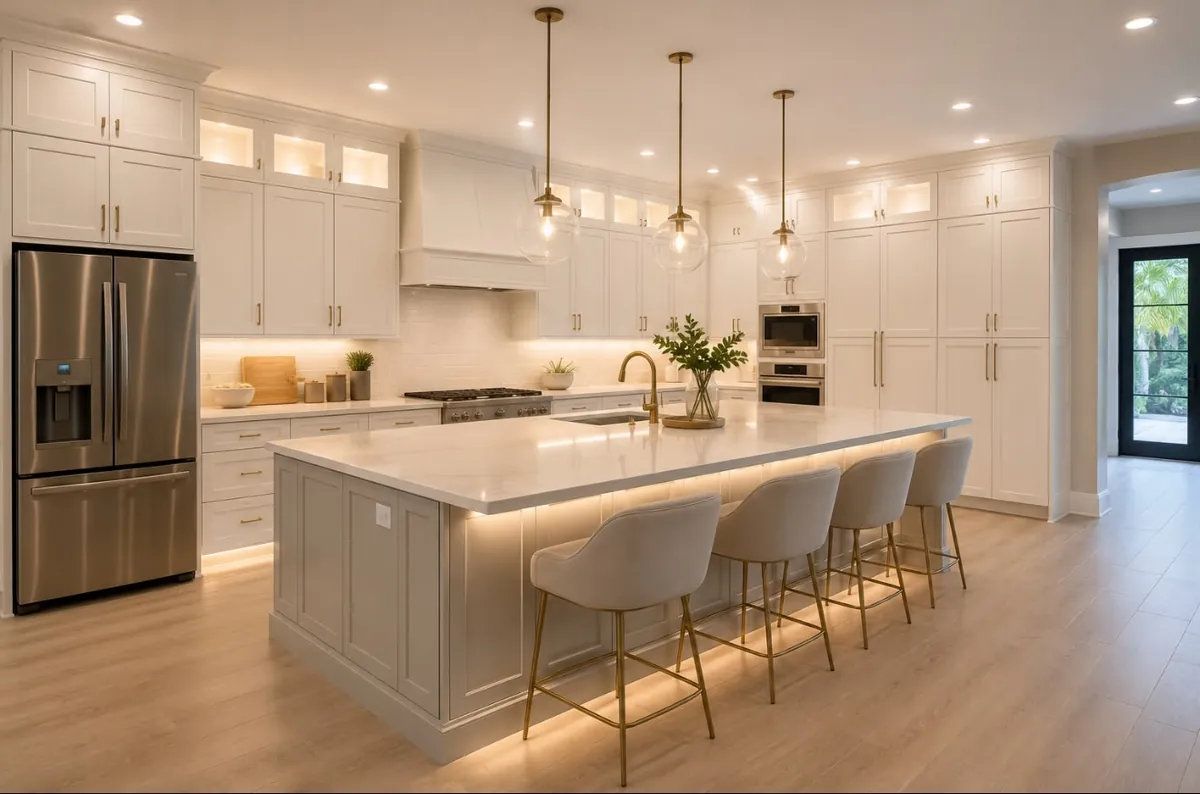
Kitchens and bathrooms in the middle of a renovation
New kitchens and bathrooms are often the heart of a renovation in an older house. They also bring the most trades into one small room. The plumber moves supply and drain lines, the electrician adds circuits for appliances, and only then do cabinets, counters and fittings go in.
The handyman’s part is the carpentry and the finish. A pro can assemble and set flat-pack or ready-built cabinets level on an uneven old floor, scribe filler strips to walls that are far from straight, fit doors and drawer fronts, and add the trim and toe-kicks that make the kitchen look built in. In a bathroom, the handyman can fit a vanity box, a medicine cabinet, mirrors, shelves and accessories into solid backing, and finish the caulk.
The connections are not handyman work. Sinks, faucets, toilets, dishwashers and the water and drain lines to them go to a licensed plumber, and any new outlet, light or vent fan to a licensed electrician. Book them in the right order, and the handyman’s visit can be the last one.
Living in the house while the work goes on
Many people renovate an older house a room at a time and live in the rest. That changes how the work is done.
A good pro keeps the dust where it is made: sheeting across doorways, a vacuum on the sander, and a clean-up at the end of each day. Doors to occupied rooms stay usable. Tools and materials are stacked out of the way, and nothing sharp or heavy is left where children or pets can reach it. If water or power has to be turned off for a trade, One Call can make sure you know in advance.
Tell the pro which rooms are in use and what has to be working by the evening, so the day’s work is planned around it.
Closets and storage in small mid-century bedrooms
Bedrooms in houses from the 1950s and 1960s are modest, and their closets are narrow, with a single shelf and a rod. Families today keep more than those closets were built for.
A handyman in Oakland Park can rebuild a closet with double hanging, adjustable shelving and drawers, fixed into the block or old framing behind. Sliding or bifold doors can be replaced with ones that open the full width. Where a room has no closet at all, a freestanding wardrobe can be anchored to the wall so it cannot tip, or a shallow built-in can be framed along a non-structural wall.
The newer infill next door
Not every house here is old. Infill houses built on cleared lots are modern construction with modern drywall, wiring and plumbing. Their handyman lists look different: builder punch-list items, nail pops, cracked caulk at trim, door adjustments as the house settles, and mounting and storage once the owners move in.
If you have a new house, check whether an item is still covered by the builder’s warranty before booking. If it is not, a handyman in Oakland Park can work through the list in one visit.
Keeping the character while modernising
Renovating a mid-century house is often about balance: keeping the parts that give it character while making it work for modern life. A handyman can help with the small decisions that add up:
- refitting original door hardware rather than replacing it, where it still works
- matching new trim to the old profile so additions do not stand out
- fitting shelves in a style that suits the house
- adding storage in places older houses lacked it, such as above doors or under stairs in a split-level
Ask the pro to bring options when the choice is not obvious. Photos of the rooms, and of any original details you want to keep, help the pro suggest pieces that suit the house rather than fight it.
Mounting on walls that were never meant for it
Block outer walls in these houses are solid and take masonry fixings well, though the old plaster on their face can crumble around a drill bit if it is not handled gently. Interior walls are less predictable. Studs may be irregularly spaced, plaster on lath does not hold a screw on its own, and an old wall may hide a disused pipe or a run of wiring nobody knew was there.
Before mounting a television, a heavy mirror or a run of shelves, a pro finds the framing, drills a small test hole where the wall is uncertain, and checks for pipes and cables. On plaster, the hole is started carefully so the surface does not crack around it. If a cable or pipe is found in the way, the mount moves, rather than the cable.
A new outlet behind a television is a licensed electrician’s job, and in an older house the electrician may need to look at the circuit first.
Older outbuildings, fences and gates
Many lots have a detached shed, a utility room off the carport, or an old wood fence. Doors on these sag, latches rust and boards split. A handyman can rehang doors, replace latches and hinges, refix loose boards and replace a broken fence section.
A carport that has been closed in without a permit, or a shed with old wiring, is a different matter. Electrical work in an outbuilding always goes to a licensed electrician, and structural changes may need a permit.
Where the line sits
Florida has no state handyman licence, so a handyman keeps to minor, non-structural work. In an older house, these always go to a licensed trade:
- Wiring of any kind, including outlets, switches, light fixtures and ceiling fans, and every old splice found inside a wall.
- Plumbing, including galvanised lines, repipes, faucets, toilets and valves.
- Gas, AC and ductwork.
- Roofs, including the low-slope roofs on many mid-century houses.
- Windows, exterior doors and shutters that need a permit, including replacing original jalousies.
- Walls that carry load, and any opening of a plan that touches structure.
One Call matches each of these with a licensed professional, so the renovation still runs through one call.
Planning a renovation with One Call
Start with the full list. Mark which items you know need a trade and which you think are handyman work, and send photos. One Call separates them, matches the trades and the handyman, and works out an order: structure and permits first, then wiring and plumbing, then the handyman closes and finishes.
You pay One Call, and One Call pays each pro. Ask what each price covers before the work begins. For larger renovations, financing is available; ask about it when you call. If anything does not hold, call One Call and it is followed up.
Questions from Oakland Park
Can a handyman in Oakland Park patch walls after a repipe?
Yes. Once the plumber has finished and the work has been inspected, the handyman closes each opening and matches the wall finish, including old plaster.
What happens if the handyman finds old wiring?
They stop and point it out. Old wiring goes to a licensed electrician, which One Call can arrange, and the handyman closes the wall afterwards.
Can a handyman fit a pocket door?
In a non-structural interior wall with no wiring or pipes inside, yes. A load-bearing wall or one with services in it needs a contractor and the relevant trades.
Can a handyman replace my jalousie windows?
No. Window replacement usually needs a permit and a rated product, so it goes to a licensed contractor. A handyman can repair the trim and patch around the new windows afterwards.
Send the renovation list
Send everything on the list, with photos, and say what has already been done. One Call matches the finishing work with a vetted, insured handyman and the trade work with licensed pros. The same service runs for handyman work in Wilton Manors and handyman service in Fort Lauderdale, and the handyman service page covers the trade in general. When you are ready, booking a handyman in Oakland Park starts on the quote page.