
If water is coming through the ceiling of a top-floor unit, the first call is often to the building, and the second is to a roofer. For roof repair in Hallandale Beach, One Call Home Pros can handle both sides: the owner or the association gets a local roofer who is licensed, insured and vetted by One Call, and we send the building’s management the insurance certificate and approval paperwork it asks for. One Call is a connector and carries no roofing licence of its own. The licensed roofer carries out the repair; One Call sets it up, checks the roofer beforehand and sees the job through.

Why Hallandale Beach homes need roof repair organised around the building
Hallandale Beach is dense and dominated by condominiums, many of them high-rise towers, with a large share of seasonal and 55-plus housing. Most homes here share a roof with many others, and that roof belongs to the building. Single-family houses, villas and townhouses make up the rest, with their own tile, shingle and flat roofs.
In a tower, a roof job is shaped as much by the building as by the roof. Contractors are admitted under building rules. Materials and tools go up by a service elevator booked in advance. The association or its management has to approve the contractor, see proof of insurance and agree when work can happen. Close to the ocean, salt air and sea wind add their own wear to every membrane, flashing and fastener. A roofer who works here needs to handle all of that, and One Call makes sure the paperwork side does not hold the job up.
Roof work One Call arranges in Hallandale Beach
Top-floor leaks
Water through the ceiling of an upper unit, traced to the roof membrane, a drain, a parapet or rooftop equipment above.
Flat and membrane roofs
Ponding, blistered or split membrane, open seams and blocked drains on condominium and commercial-style roofs.
Parapets and coping
Cracked parapet walls and loose coping caps, where water enters the top of the building’s walls.
Equipment curbs and penetrations
Leaks round air conditioning curbs, exhaust fans, vent stacks and roof hatches.
Villa and house roofs
Cracked tile, lifted shingle, flashing and fascia on single-family homes, villas and townhouses.
Storm documentation
Pictures and notes on storm damage for whichever insurer covers the roof, the owner’s or the association’s.
Whose roof is it
Before anything else, it helps to know who is responsible for the roof over you. In most condominiums the roof is a common element. The association owns it, maintains it and arranges its repair, and the cost is shared through the association. A unit owner with a leak reports it to management, and the association hires the roofer.
There are variations. In some villa and townhouse communities, each owner is responsible for the roof over their own unit. In others, the association handles roofs but the owner handles the interior damage. Your declaration and the association’s rules set this out. If you are not sure, ask management before you book anything.
Either way, One Call can help:
- If the roof is yours, One Call finds you a roofer and forwards the association whatever proof of insurance and forms it wants.
- If the roof is the association’s, a board member or manager can call One Call to arrange a roofer for the building. Roofers in the network take on condo high-rise jobs.
Getting a roofer onto a tower
A roof on a high-rise is reached from inside, through a stairwell and a roof hatch or door, with materials carried up by elevator. That brings rules that do not apply to a house:
- Contractor approval. Management usually wants the contractor’s certificate of insurance before they are allowed in, sometimes naming the association.
- Elevator booking. Service elevators are reserved for set times, often with padding fitted to protect the cab.
- Working hours. Many buildings limit contractor work to certain hours and days.
- Roof access. The hatch or door is locked, and someone from the building has to open it.
- Protecting common areas. Hallways, lobbies and elevators have to be kept clean and undamaged.
When you call, tell One Call the building’s name, who manages it and anything you know about its contractor rules. One Call sends the roofer’s insurance certificate and the approval paperwork to the building, and the roofer is briefed on access before arriving.
Flat roofs on condominium buildings
Almost every condominium tower and mid-rise has a flat or low-slope roof, usually a membrane system or a built-up roof. These roofs do not shed water quickly. They rely on a gentle slope to drains and scuppers, and on the membrane staying whole.
What tends to go wrong:
- Ponding. Water that sits in low spots after rain wears the membrane and finds any weakness.
- Seams. The joints between membrane sheets open under sun and movement.
- Drains. Leaves, debris and nesting birds clog drains, and water backs up.
- Blisters and splits. The membrane bubbles in heat and cracks as it ages.
- Flashing at edges and walls. Where the membrane turns up a parapet or a wall, it pulls away and lets water in behind.
Leaks from a flat roof often show in a top-floor unit some distance from where water enters, because it travels across the deck before finding a way down. A roofer works back from the unit’s ceiling to the area of roof above, checking drains, seams and edges in turn.
Parapets, coping and the top of the wall
Most condominium roofs are edged by a parapet, a short wall that rises above the roof surface. Its top is capped with metal or concrete coping. The parapet is one of the most common sources of top-floor leaks, and one of the most misread, because the water that gets in at a cracked coping joint or a split in the parapet stucco runs down inside the wall rather than across the roof.
The signs inside a top-floor unit are stains along the top of an outside wall, paint bubbling near a window head, or damp in a corner rather than in the middle of a ceiling. If that is what you see, say so when you arrange roof repair in Hallandale Beach. The roofer checks the coping joints and fastenings, the stucco on both faces of the parapet, and the flashing where the roof membrane turns up the wall.
Rooftop equipment
Tower roofs carry a lot of equipment: air conditioning condensers and chillers, exhaust fans, elevator machine rooms, antennas, and the curbs and stands that support them. Every piece passes through or sits on the roof, and each has a seal or a flashing around it. Vibration, service visits and the sun wear those seals down.
When a leak is near equipment, the roofer checks whether it is the roof flashing, the curb, or the equipment itself, since condensation from air conditioning can look exactly like a roof leak. If a unit has to be lifted so the roofing under it can be fixed, an air conditioning or mechanical contractor will need to be involved, and One Call can arrange that too.
Roof hatches, doors and stair towers
Every tower roof has a way up: a hatch at the top of a ladder, or a door from a stair tower or an elevator machine room. These are some of the most overlooked leak points on a building. Hatch lids lose their gaskets, curbs crack, and door thresholds at roof level let wind-driven rain straight into the stairwell. Stair towers and machine rooms also have small roofs of their own, often forgotten because they sit above the main roof.
If water shows in a top-floor corridor, a stairwell or near the elevator lobby, mention it. The roofer will check these access points along with the main roof, since a worn gasket or a failed threshold is a quick repair compared with the damage it causes.
Low-rise and garden-style buildings
Not every condominium here is a tower. Older garden-style and low-rise buildings of a few floors are common, often several buildings to an association, with flat roofs, external stairs and walkways. Their roofs are easier to reach, but the questions are the same: who owns the roof, what the association needs before a contractor starts, and where the water is coming in.
Flat roofs on these buildings often carry the condensers for every unit below, each on its own stand, with refrigerant lines running across the membrane. Every stand and every line crossing is a possible leak point, and service visits for the air conditioning wear the membrane around them. When a top-floor unit leaks in a building like this, roof repair in Hallandale Beach usually starts with the equipment above that unit.
Salt, sun and sea wind
Hallandale Beach sits right on the coast, and buildings near the ocean take salt air and sea wind every day. On roofs, that shows up as:
- Metal flashing, coping caps and fasteners corroding faster than inland.
- Membrane surfaces weathering more quickly under sun reflected off water.
- Sealants around penetrations drying and cracking.
- Wind lifting membrane edges and coping on the most exposed side of the building.
Repairs on the coast hold up better with materials chosen for salt exposure: stainless or coated fasteners, flashing and coping metals that resist the sea air, and sealants made for coastal use. Ask the roofer what they plan to use.
Villas, townhouses and houses
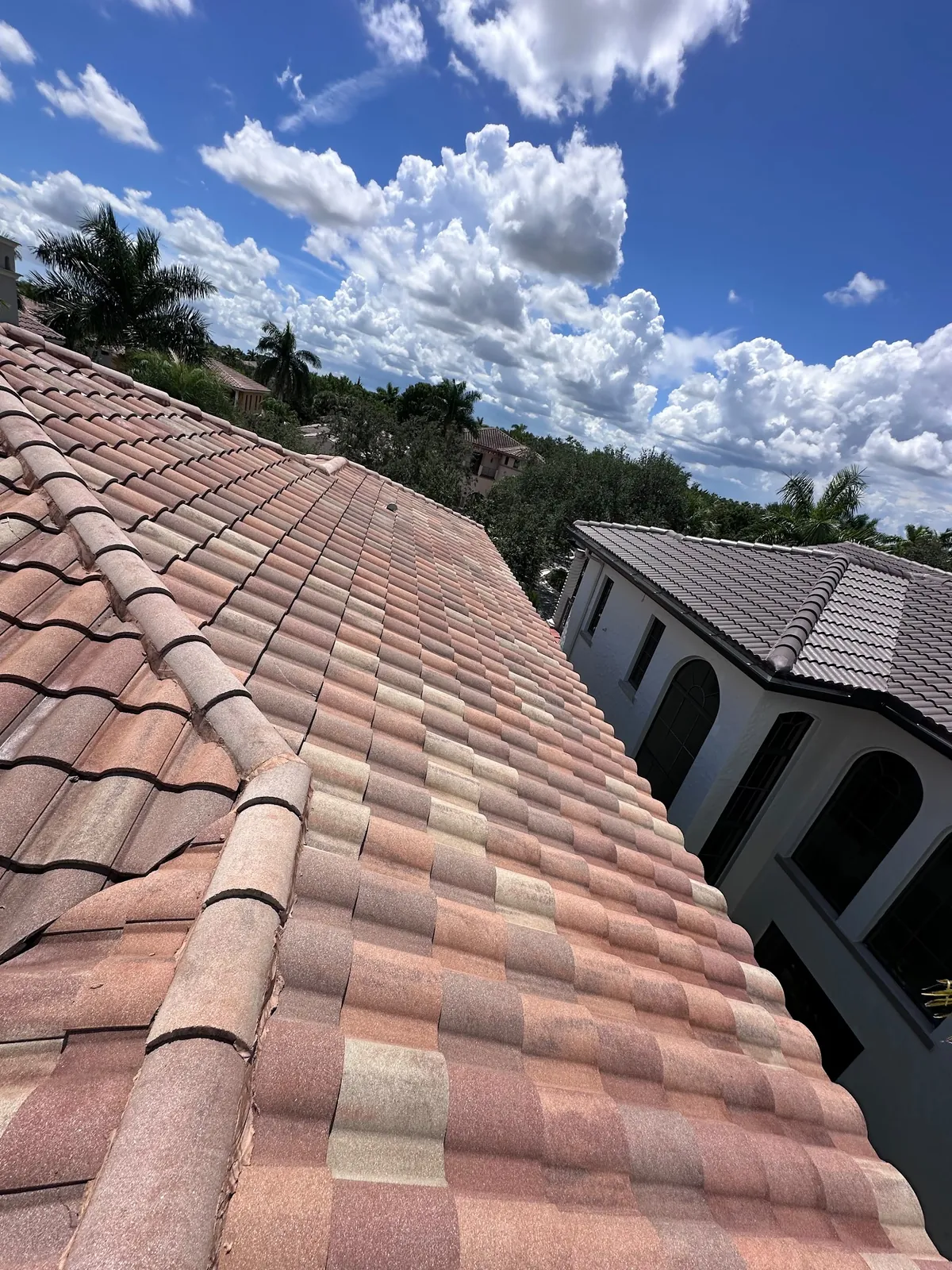
Away from the towers, roof repair in Hallandale Beach looks much as it does elsewhere in the county. Houses, villas and townhouses wear concrete tile or shingle, often with a flat roof over a carport or patio. The usual problems are cracked or slipped tile, lifted shingles, failed vent boots and wall flashing, and soft fascia at the eaves, with salt air adding to the wear on metal.
On attached villas and townhouses, a roof often runs continuously over several units. A leak in yours may start over a neighbour’s, and a repair at the party line may involve the roof on both sides. Your association’s rules will say how that is handled. Mention when you call that the roof is shared, so the roofer comes prepared.

If you are away when it leaks
Many homes here sit empty for part of the year. A leak that starts while you are away can run for weeks before anyone notices. A few steps help:
- Ask a neighbour, a friend or the building’s management to look in after heavy storms.
- Leave a key and a contact number with someone who can let a roofer in.
- Give One Call the name of the person who will meet the roofer, so the visit can go ahead in your absence.
- Ask for photos of the damage and the repair to be sent to you.
One Call can coordinate a repair while you are out of town, as long as someone can give access to the unit and the building.
Reporting a leak in a condominium
If water appears in your unit:
- Protect your belongings and catch the drip.
- Photograph the ceiling and anything damaged, with the date.
- Report it to management in writing, with the photos.
- Ask whether the association is arranging the roof repair, or whether it falls to you.
- Keep a record of every conversation.
If the association handles the roof, management arranges the roofer. If it falls to you, call One Call. In both cases, interior damage to your unit, such as the ceiling, paint and flooring, is often handled separately from the roof itself.
Storms on the coast
Coastal buildings take the full force of storms coming off the ocean. After a storm, building management will usually inspect common roofs. For a house or villa, once it is safe:
- Scan each slope from the street or the yard for gaps in the tile, curled shingle or flashing torn loose.
- Gather roof debris from the yard and hold on to it.
- Look at the ceilings again over the next several days.
- Photograph all of it with the date.
Where the wind has opened a roof, a temporary tarp from the roofer keeps the rain out until the permanent repair.
Insurance on shared roofs
In a condominium, the roof is typically on the association’s master policy, while your own policy covers your unit’s interior and contents. For a villa or house, the roof is usually on your own policy. Read your documents to see where the line falls. Any claim is between the policyholder and their insurer; the roofer is not the adjuster. The roofer’s contribution is evidence: images from the roof deck and a written summary of the damage and the remedy, usable by you, the board or either insurer.
Permits
As part of Broward, the city falls within the High-Velocity Hurricane Zone, whose wind standards cover roofing on every type of building. Anything beyond a small fix is permitted and inspected, with the licensed roofer making the application. On a condominium building, the association’s approval is a separate step, and both are needed before work begins.
Re-roofs and larger projects
When a building’s membrane or a villa’s tile roof has reached the end of its life, repairs stop holding. You will be told when that point has come. Complete re-roofs, condominium buildings included, are within the network’s work, and for a project that size financing is available; raise it on the phone. On a condominium, a re-roof is an association decision, often planned well ahead.
How One Call arranges it
- You call or send the quote request. Tell us whether it is a condo unit, a building roof, a villa or a house, and who is responsible for the roof.
- Give us the building or association name and the manager’s contact.
- One Call chooses a roofer from its checked network with the licence, insurance and experience that roof calls for.
- Management or the association receives the roofer’s proof of insurance and the forms it requires, sent by One Call.
- The roofer inspects, explains the cause and the repair, and the price and what it covers are settled before any membrane is cut.
- Work proceeds under a permit where the job needs one. Should the ceiling stain return, One Call sends the roofer back to it.
Whether the client is an owner or a board, billing is the same: One Call invoices, and One Call pays the roofer.
Owners and boards just inland or up the coast can use the Pembroke Park roof repair page or the Hollywood roof repair page.
Questions from Hallandale Beach
Water is coming into my top-floor condo. Who arranges the repair?
Usually the association, since the roof is normally a common element. Report it to management in writing. If your documents put the roof on you, One Call can match a roofer and send the building the paperwork.
Can One Call send paperwork to my building?
Yes. The roofer’s certificate of insurance, along with the approval forms, can go from One Call straight to your condo or homeowners’ association, or to its manager.
Do the roofers work on high-rise buildings?
Yes. High-rise condominium roofs and flat roofs are both work the network’s roofers take on. Tell One Call about the building’s access rules so the roofer is prepared.
Can roof repair in Hallandale Beach go ahead while I am away?
Yes, if someone can give the roofer access to your unit and the building. Give One Call that person’s name, and ask for photos of the repair.
Arrange the roof repair
Tell One Call where the water is, what kind of building it is and who manages it. One Call lines up a licensed roofer it has vetted and takes care of the papers the building asks for.