
If you plan to swap a tired light fixture for something better, or to move from a gas range to induction, check two things before you buy anything: what your panel can carry, and where a new circuit could run. In a compact mid-century house, the answer shapes the whole project. Electricians in Wilton Manors can be booked through One Call Home Pros, which arranges the work but does not do it. One Call holds no electrical licence. Tell us what you are planning or what has gone wrong, and we find a vetted professional who is licensed and insured for it, book the visit and keep track of it to the end.

Why Wilton Manors homes need electrical work planned around upgrades
Wilton Manors is small and closely built, and most of its houses are mid-century, from the years after the war through the 1960s. A great many have been or are being renovated, and the work here is usually an upgrade, not a straight swap. Owners replace a single ceiling light with layered lighting, a basic kitchen with a chef’s one, and a window unit with a ducted or ductless system. Each of those changes adds electrical load to a house that was built with very little.
The lots are compact and the side setbacks are tight. Meters, panels, AC condensers and pool equipment often sit in a narrow strip between the house and the neighbour’s fence. That affects where new equipment can go, how the electrician reaches the panel, and how a new cable gets from one end of the lot to the other.
Good electrical work here starts with two questions: what will the house carry after the upgrade, and how will the equipment fit on the lot.
How electricians in Wilton Manors can help
The jobs below come up again and again in mid-century houses being brought up to date.
Panel capacity for upgrades
Load calculations, panels with no free spaces, and service upgrades when a renovation adds major appliances.
Lighting design and dimming
Layered lighting, recessed and pendant lights, under-cabinet lighting and dimmers that suit LED fittings.
Kitchen and laundry circuits
Dedicated circuits for induction cooking, wall ovens, dishwashers, and modern washers and dryers.
Outlets and GFCI
Dead or loose outlets, original two-slot outlets, and ground fault protection where water is near.
Fans indoors and out
Ceiling fans on proper supports in living rooms and bedrooms, and wet-rated fans on patios.
Chargers and surge
Car charger circuits that fit a tight lot, and surge protection for a house full of new equipment.
Upgrading, not replacing like for like
A like-for-like swap rarely needs much thought. An upgrade does, because it usually adds load. An induction cooktop draws more than many old electric ranges. A wall oven and a separate cooktop need two heavy circuits instead of one. A heat pump dryer, a wine fridge, a steam oven, heated floors in a bathroom, and an outdoor kitchen each add their share.
Before choosing appliances, it is worth asking a pro to do a load calculation. That compares what the house will draw with what the service and the panel can supply. The answer tells you whether the upgrade fits as things stand, needs a few new circuits, or needs a larger panel or service. Knowing that early avoids buying an appliance the house cannot run.
If the calculation points to a panel or service upgrade, that is a larger job with a permit, an inspection and coordination with the utility, all of which the licensed pro arranges. Financing is available for larger work; ask about it when you call.
Lighting that does more
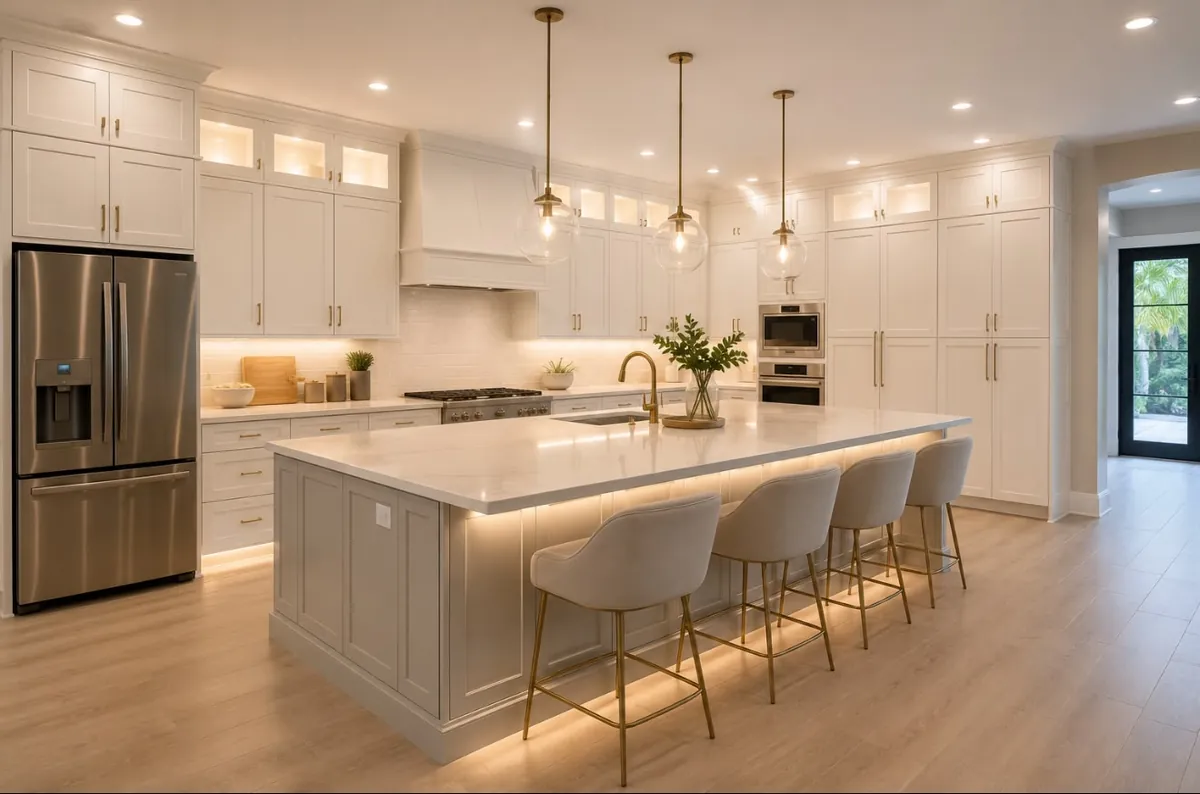
Mid-century houses were lit by a single fixture in the middle of each ceiling, if that. Remodels here often add layers: recessed lights for general light, pendants over an island, wall washers on art, under-cabinet strips, and accent lighting in shelving and outside.
A few points make lighting work properly:
- Choose dimmers for the fittings. LED fixtures need dimmers made for them, or they flicker, buzz or will not dim smoothly.
- Check the ceiling depth. Low ceilings and shallow framing in older houses limit the kind of recessed fixture that fits. Thin wafer lights are often the answer.
- Plan the switching. Group lights by how the room is used, so the right ones come on together.
- Mind the insulation. Fixtures in contact with insulation must be rated for it.
Smart switches and dimmers add scenes and schedules without rewiring the whole house. Many need a neutral wire in the switch box, which older houses sometimes lack. A pro can check.
Panels in mid-century houses
Original panels in houses of this age were small. Many have been replaced once already, sometimes with another small panel. Some makes installed in the decades since carry a poor record of breakers that do not trip as they should. A panel with no spare spaces, breakers doubled up, rust inside, or breakers that are warm all point towards replacement.
When a panel is replaced as part of a remodel, it makes sense to size it for what the house will become, not what it is now. Leaving spaces for a charger, a future pool or an outdoor kitchen saves another upgrade later.
Tight side yards and equipment access
On compact lots with narrow side setbacks, space beside the house is limited and much of it is already taken. The meter and the main panel are often on a side wall, and the AC condenser, the pool equipment and the water heater may be right beside them, with a fence a short step away.
That matters in several ways:
- Working space at the panel. Code requires clear working space in front of an electrical panel. A new AC unit, a shed or a pile of pavers placed in front of it can block that, and an inspector will not accept it.
- Room for new equipment. A charger, a new disconnect or a larger panel needs wall space and clearance. On a tight lot, the pro may need to suggest a different location.
- Getting cable across the lot. A cable to a detached garage, a pool house or the back fence may need to run under paving or along the house. On small lots, the route can be the hardest part of the job.
- Access on the day. Gates, fences, dogs and parked cars in a narrow side yard all affect how the pro reaches the work.
When you call, tell us where the panel is, what is around it and how the pro gets to it.
Faults that cannot wait for the remodel
Some problems should be dealt with now, whatever the renovation timetable says. Switch off the circuit, or the main breaker if it is safe to reach, and call if you notice:
- An outlet, switch or breaker that is warm, discoloured or smells of hot plastic
- A tingle from a tap, a fixture or an appliance
- Lights that dim and brighten across several rooms at once
- A breaker that trips again the moment it is reset
These usually point to a loose connection, a damaged cable or a problem at the panel, and an old house will not fix itself while it waits for the new kitchen. If there is smoke or flame, leave the house and call the fire department first.
Ductless AC and new mechanical loads
Many renovations here replace window units or old systems with ducted heat pumps or ductless mini splits. Each outdoor unit needs its own circuit and a disconnect within sight of it. On a tight side yard, the location of the outdoor unit and its disconnect must leave room for service and for the panel’s working space. The AC contractor installs the equipment. The circuit, the disconnect and the panel space are electrical work. Getting both trades to agree on the location before installation avoids moving things later.
Kitchens with induction and wall ovens
Induction cooking is a common choice in remodels. It needs a heavy dedicated circuit sized for the cooktop. A separate wall oven needs another. Add a dishwasher, a disposal, a microwave drawer, a refrigerator and counter circuits with ground fault protection, and the kitchen alone may need more circuits than the whole original house had. Ask a pro about the kitchen’s circuits before the cabinets are ordered, so the panel and the cable runs are planned with the layout.
Bathrooms and laundry
Remodelled bathrooms often add heated floors, heated towel rails, lit mirrors and exhaust fans on humidity sensors. Each has its own needs, and bathroom outlets need their own circuit and ground fault protection. Laundry rooms moved inside from a carport or a garage need new circuits and protection near water. A pro can work these into the plan with the rest of the remodel. Heated floors in particular have to be wired and tested before the tile goes down, so the electrician needs a slot in the schedule between the floor prep and the tiler.
Original outlets and wiring in untouched rooms
Not every room is opened up. In rooms keeping their original wiring, two-slot outlets can be replaced with GFCI outlets labelled correctly, which gives shock protection without a ground. Original cable may have brittle insulation at fixtures. A pro can test the circuits that remain and suggest which to replace while other work is going on.
Ceiling fans
Fans run most of the year. A new fan should hang from a box rated for fan support, fixed to the framing. On low mid-century ceilings, a flush-mount fan keeps the blades at a safe height. Patio fans need a damp or wet rating. Many owners like fans with a remote or a wall control rather than pull chains; that may need new wiring between the box and the switch, which a pro can advise on.
Car chargers on a compact lot
A charger needs a dedicated circuit and space in the panel. On a lot with a short driveway or no garage, the question is often where the charger can go. The best spot is near where you park and close to the panel, with the cable route kept short and protected. If the panel is on the far side of the house, the run is longer and harder on a tight lot. The pro will look at the panel, the parking and the route together. Electricians in Wilton Manors see these layouts all the time and can suggest the simplest option.

Low roofs and little attic space
Many mid-century houses here have low-pitched roofs, and some have barely any attic at all. That makes running new cable harder than in a newer house with a tall roof space. An electrician may have to fish cable through tight gaps, route it along the outside in conduit, or plan new circuits around the rooms being opened. The route shapes how long the job takes, so it is worth knowing early. When you talk to electricians in Wilton Manors about new lighting or circuits, mention whether the attic is reachable, and whether a roof replacement is coming, since the roof deck being off is the easiest time to run cable in some houses.
Pools on small lots
A pool squeezed onto a compact lot puts water, pumps, heaters and lights close to the house, the fence and the neighbour’s property. Pool equipment needs its own circuits, a disconnect, bonding of everything metal near the water, and ground fault protection on lights and outlets. On a tight lot, the equipment pad often ends up in the side yard next to the panel and the AC, which brings back the working-space question. Plan the pool’s electrical with the pool builder before the pad is poured.
Outdoor living
Small lots make the most of outdoor space: covered patios, pergolas with lights and fans, outdoor kitchens, string lights and landscape lighting. Each outdoor outlet needs ground fault protection and an in-use cover. Fixtures need wet ratings. Low-voltage landscape lighting runs from a transformer that needs an outdoor outlet. If the patio is new, plan the outlets and fan boxes before the roof or pergola is finished.
Surge protection for new equipment
A remodelled house is full of electronics: induction cooktops, smart appliances, variable-speed AC, smart switches and home office equipment. A surge from lightning or the grid can damage any of them. A whole-house surge protector at the panel is a modest addition to a remodel and protects everything at once.
Small jobs worth bundling
While a pro is at the house for a larger job, a list of small items can usually be worked through in the same visit: a loose outlet, a switch that sticks, a doorbell transformer that has died, a bathroom fan that rattles, or a porch light that rusted. In a house of this age, small faults add up, and dealing with them together keeps return visits down. Write the list before the visit and hand it over at the start.
Living in the house during the work
Most upgrades can be done while you live there, though some mean the power is off for part of a day. A panel change cuts the whole house, and the utility may need to disconnect and reconnect the service. Plan for that: the refrigerator, any medical equipment, the home office and the pets. The pro can tell you how long the house will be without power and what to switch off beforehand.
Permits and inspections
Upgrades that add circuits, change the panel or the service, or install a charger need a permit and inspections. In a remodel, the electrical inspection is scheduled with the building inspections, so the electrician’s rough-in has to be ready before the walls close. The licensed pro applies for the electrical permit. Keep the closed permits; you will want them when you insure or sell the house.
One Call’s part
The electrician holds the licence for the work, not One Call. When you ask us to find electricians in Wilton Manors, we want to hear what you are changing, what the house has now, where the panel sits and how the side yard is laid out. With that, we choose a vetted pro licensed and insured for the work, and help line up the timing with your other trades.
The pro assesses and explains what the upgrade needs. Small jobs are done on the visit. Larger work is priced so you can decide. You pay One Call, and One Call pays the pro. Ask what the quote covers before work begins, including permits. If anything goes wrong later, call One Call.
Questions from Wilton Manors
Can my panel handle an induction cooktop?
Possibly, but not always. A load calculation shows whether there is room. If not, a larger panel or service may be needed.
Why do my new LED lights flicker on the dimmer?
The dimmer may not suit LED fittings. A dimmer made for LED loads usually fixes it.
There is no room beside my panel for a charger. What are the options?
The pro can look at other locations, routes for the cable and, if needed, moving equipment that blocks the panel’s working space.
My AC installer wants to put the new unit in front of my panel. Is that allowed?
No. The panel needs clear working space. The unit should go elsewhere.
Book it with One Call
Tell us what you are upgrading, where the panel is and how to get to it. One Call matches you with a vetted, licensed electrician and stays with the job. Neighbouring Oakland Park and Fort Lauderdale are covered the same way, and the Coral Springs electrical page explains each kind of electrical job.