
On the question of tile vs shingle in Florida, neither is simply better. Both are built to the same strict wind code in Broward County, and both can serve a house well. They fail in different ways, though. A tile roof usually leaks because the underlayment beneath the tiles has worn out or a tile has cracked or slipped. A shingle roof usually leaks because wind has lifted or torn shingles, or the sun has worn them down. Knowing how your roof fails helps you read the warning signs and understand what a repair will involve.
How each roof keeps water out
The two roofs work on different principles.
Tile roofs. Clay or concrete tiles shed most of the rain, but they are not watertight on their own. Water gets under them in wind-driven rain. The real waterproofing is the underlayment, a membrane fixed to the roof deck beneath the tiles. The tiles protect the underlayment from the sun and from debris. The underlayment keeps the water out.
Shingle roofs. Asphalt shingles are the waterproof layer and the visible surface at once. They overlap, and a strip of sealant bonds each course to the one below so wind cannot get under it. There is underlayment beneath shingles too, but the shingles do most of the work.
That difference explains most of what follows in the tile vs shingle Florida comparison: a tile roof can look fine while its underlayment fails underneath, and a shingle roof shows its wear on the surface.
How tile roofs fail here
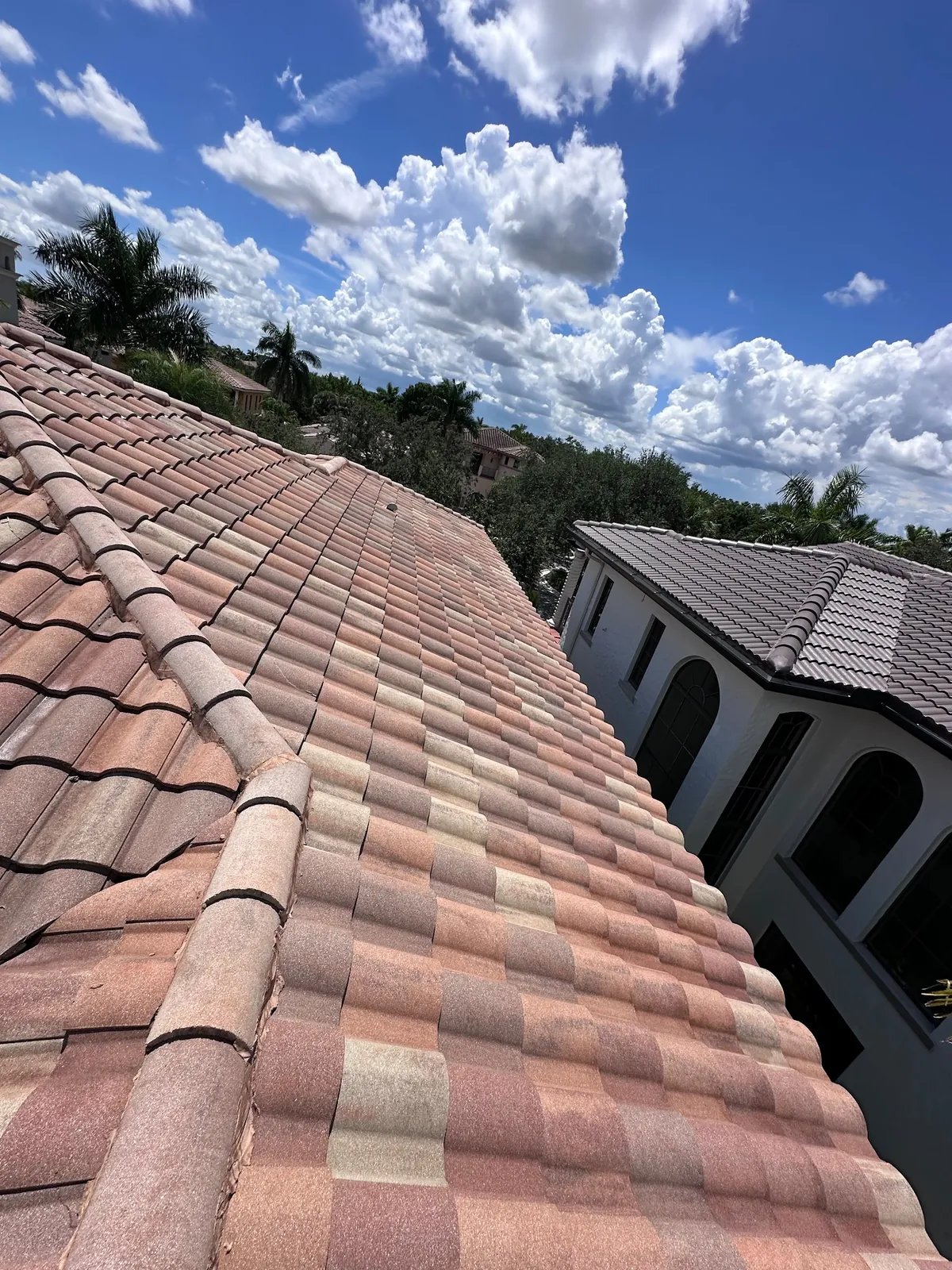
Tile roofs are heavy and durable, and the tiles themselves can outlast the materials beneath them. Common problems:
- Underlayment wear. Under years of heat, the underlayment dries out, cracks and loses its seal. Leaks often appear without any visible change to the tiles.
- Cracked and broken tiles. Falling branches, debris in a storm, and people walking on the roof all crack tiles. A cracked tile lets more water reach the underlayment.
- Slipped tiles. Tiles can shift if their fasteners or adhesive fail, leaving gaps.
- Ridge and hip tiles. The tiles along the ridges and hips are set differently from the field tiles and are more exposed to wind. They can loosen and lift.
- Valleys and flashing. Where two roof slopes meet, or the roof meets a wall, water concentrates. Debris collects in valleys and holds moisture.
How shingle roofs fail here
Shingles take the full force of the sun and the wind directly.
- Wind lift. Strong gusts can break the sealant bond and lift shingles. Once lifted, a shingle can crease, tear or blow off.
- Granule loss. The granules on top of the shingle protect it from the sun. As they wear off, the shingle ages faster. You may see granules in the gutters or at the bottom of downspouts.
- Curling and cracking. Heat and sun dry shingles out over time, and they curl at the edges or crack.
- Flashing and pipe boots. The rubber boots around vent pipes crack in the sun, and the flashing around walls and chimneys can come loose.
- Algae streaks. Dark streaks are common on shingles in humid climates. They are mostly cosmetic, but they show where moisture lingers.
What repairs look like on each
Tile repairs. A roofer replaces cracked or broken tiles, resets slipped ones and re-secures ridge and hip tiles. If the underlayment has failed in one area, the tiles there are lifted, the underlayment is repaired or replaced, and the tiles go back down. Tiles break easily when handled, so a careful roofer works slowly. Matching tile can be difficult on an older roof, since some profiles and colours are no longer made. Spare tiles left over from the original installation are worth keeping for this reason.
Shingle repairs. A roofer replaces damaged shingles, reseals lifted ones where they can be saved, and replaces worn flashing and pipe boots. Matching shingles is usually easier, although new shingles may look brighter than weathered ones for a while.
When repair is not enough. On both roofs, there comes a point where repairs stop making sense. On a tile roof, it is often when the underlayment is failing across much of the roof. On a shingle roof, it is often when the shingles are brittle and losing granules widely. The building code can also require more than a patch when a large share of a roof is damaged. A roofer will tell you where your roof stands, and whether a full re-roof is the better choice.
What wind exposure does over time
Broward County sits in the High Velocity Hurricane Zone, the strictest wind area in the Florida Building Code. Both roof types are installed to that standard, but wind still wears them, storm after storm.
On tile. Every strong wind event puts stress on the fasteners and adhesive that hold each tile. Ridge and edge tiles take the most. Over time, small movements loosen tiles that were firm. Debris thrown by the wind cracks tiles, and each cracked tile lets in a little more water. The underlayment beneath takes the hidden toll.
On shingle. Repeated gusts work at the sealant bond along each course. A shingle that lifts once is easier to lift the next time. Edges, rakes and ridges, where the wind first grips, show it first. After a big storm, a shingle roof often has damage you can see from the ground.
Location matters. Houses near the coast face stronger wind and salt air, which corrodes metal flashing and fasteners faster. Houses with tall trees nearby face more debris. Roofs with steep slopes or large overhangs catch more wind at the edges.
The practical result for tile vs shingle in Florida: tile damage is often hidden until a leak appears, while shingle damage is often visible early. Regular inspections, and an inspection after each major storm, catch both.
Choosing between them on a re-roof
If you are replacing a roof, the choice of tile vs shingle in Florida is a real one, and both options can be right. Points worth discussing with the roofer:
- Weight. Tile is much heavier. A house built for shingles may not carry tile without a structural review.
- Association rules. Many associations specify the roof material, profile and colour.
- Insurance. Insurers look at roof type and age. Ask your agent how each would affect your policy.
- Repair access. Tile is harder to walk on and repair. Shingle is easier to work on.
- Appearance. The look of the house and the street matters, especially within an association.
The tile vs shingle in Florida decision is best made with the roofer looking at your house, its structure and your association’s rules. A re-roof needs a permit either way, and financing is available for larger roof work; ask about it when you call.
How One Call fits in
One Call Home Pros is a connector, not a roofing company. Tell us what kind of roof you have and what you are seeing, and we match you with a vetted, licensed, insured local roofer who works on tile, shingle and flat roofs. The roofer inspects, explains the findings and does the repair or the re-roof. One Call arranges it, vets the roofer and stays with the job. You pay One Call, and One Call pays the roofer.
Related services
Roof repair
Tile, shingle and flat roof repairs, and full re-roofs.
After a storm
What to check from the ground after high wind, and how to record it.
Get the roof inspected
Whether your roof is tile or shingle, an inspection tells you where it stands. Tell One Call what you have, and we connect you with a vetted, licensed local roofer.