
Salt, age and storms are the three things that wear a roof out fastest, and many houses near the water face all three. For roof repair in Dania Beach, call One Call Home Pros and describe what you see. We put you in touch with a roofing professional who is vetted, licensed and insured, who finds where the water is getting in and fixes it. One Call is not a roofing company and holds no roofing licence. The roofer does the repair; One Call arranges it, checks the roofer’s credentials and keeps the job moving.

Why Dania Beach homes need roof repair suited to their age
Dania Beach is old Broward. Its historic core holds houses from the early and middle decades of the last century, many of them small, single-storey and built long before the current wind code. Along the water, the marine industry sits beside homes, and the Intracoastal brings salt air into every street close to it. Around the edges, newer townhouses and condominiums have been going up, with their own construction and their own associations.
That mix means there is no single kind of roof here. A house in the older core may have a low-pitched or flat roof over board decking that has been patched more than once. A home near the water may have flashing, fasteners and drip edge corroded by salt well before their time. A newer townhouse may have a tile roof managed in part by an association. A roofer who works here needs to know which one is in front of them, and One Call passes on what you tell us so the match fits.
Roof repairs One Call arranges in Dania Beach
Leaks through older ceilings
Water through plaster or drywall during storms, followed back to the real entry point on the roof.
Flat and low-slope roofs
Ponding, open seams, blistered membrane and clogged drains on flat and low-pitched sections.
Salt-worn metal
Flashing, drip edge, vent pipes and fasteners corroded by salt air near the Intracoastal.
Tile and shingle damage
Cracked or missing tile and lifted shingle tabs, with the layers beneath checked.
Fascia and soffit
Rotted roof edges, which on older houses often hide softened rafter tails.
Storm and insurance records
Photographs and a written account of storm damage for you to give your insurer.
Salt air and the metal on your roof
Every roof relies on metal in places you rarely see: flashing where the roof meets a wall or a chimney, the drip edge along the eaves, valley metal, vent stacks and a great many fasteners. Near the Intracoastal, salt carried on the breeze settles on all of it. Moisture turns that salt into a slow, steady corrosion.
What it looks like:
- Rust streaks running down the fascia or the stucco below a roof joint.
- Flashing that has thinned, pitted or come away from the wall.
- Nails and screws with heads rusted through, so shingles, tiles or panels lose their grip.
- Drip edge that has rusted along the bottom, letting water run behind the gutter.
- Gutters and their brackets corroding where they meet the fascia.
Repairs near the water usually go better with materials suited to salt exposure: corrosion-resistant fasteners, and flashing in metals and finishes that hold up in coastal air. Ask the roofer what they plan to use and why. A repair made with ordinary metal can fail again sooner in this setting.
Older houses in the historic core
Houses from the early and middle decades of the last century were built with different methods from today’s homes. Many have:
- Board decking rather than plywood sheets, which can shrink, split and rot at the joints.
- Low-pitched or flat roofs, common in mid-century designs, which drain slowly.
- Several layers of repair, each from a different era, sometimes with materials stacked on top of one another.
- Open rafter tails or exposed eaves, which rot where water sits on them.
A leak in a house like this can be harder to trace because water travels along old boards and through gaps in the decking. The roofer often needs to open up a section to see what is underneath. If wood has rotted, the deck and sometimes rafter ends need repair before any new roofing goes down. That is real work and it is worth doing properly; a membrane or shingles over soft decking will not hold.
Flat roofs and ponding
Flat and low-slope roofs are common on older houses here, on carports, Florida rooms and additions, and on some commercial-style buildings along the water. They do not shed water the way a pitched roof does. Water collects in low spots, sits in the sun, and works into any weakness.
Signs to look for from inside and from the ground:
- Stains on the ceiling under the flat section, often near the middle or at one corner.
- Water still standing on the roof a day or more after rain, if you can see it from a window or a higher floor.
- Blisters or bubbles in the roof surface.
- A gutter or scupper that overflows rather than drains.
The roofers One Call works with repair flat roofs as well as pitched ones. The fix might be resealing seams, patching or replacing a section of membrane, clearing and rebuilding a drain, or correcting a low spot. Tell One Call the roof is flat when you call.
Gravel roofs and built-up layers
Some older flat roofs in town are built-up roofs: layers of felt and hot asphalt finished with a coat of gravel. They were standard on mid-century houses and are still found on carports and back rooms. Gravel protects the layers below from the sun, but where it washes or blows away, the bare asphalt beneath cracks and blisters. Gravel also hides problems, because you cannot see the surface under it.
If you have a gravel roof, tell One Call when you call about roof repair in Dania Beach. Repairing one involves clearing the gravel around the problem, cutting out and rebuilding the damaged layers and putting the gravel back, or, where the roof is near the end of its life, a conversation about a modern membrane instead. The roofer will set out the choice once they have seen it.
Air conditioning on the roof
Older houses with flat roofs often have the air conditioning equipment up there: a package unit on a stand or curb, refrigerant lines and a condensate drain running across the roof, and ducts passing down through it. Every one of those passes through the roof membrane, and each is a possible leak. Units are also heavy, and the roof under them takes wear from service visits.
When the leak is near the equipment, the cause can be the roof, the curb flashing, or the unit itself dripping condensate. The roofer can tell which. If the roof needs work under the unit, it may need to be lifted or disconnected, which is work for an air conditioning technician. Mention any rooftop equipment when you call, so the visit can be planned around it.
The joint where old meets new
Many older houses have been added to over the decades: a bedroom built out at the back, a carport closed in, a porch roofed over. Each addition left a seam where a newer roof joins an older one, often at a different pitch and in a different material. Those seams leak more than any other part of an older house. If the stain appears near a room that was added later, the roofer will start there.
Newer townhouses and condominiums
Not every roof in town is old. New development along the edges has brought townhouses and condominium buildings with tile and flat roofs built to modern code. On these, the question is often who is responsible. In many associations the roof belongs to the association rather than the owner; in others, each owner looks after the roof over their unit.
Check your documents before you call. If the roof is yours to repair, One Call matches you with a roofer and can send the roofer’s insurance certificate and the approval paperwork to your homeowners’ or condo association. Roofers in One Call’s network also take on condo high-rise jobs and flat commercial-style roofs, so if you sit on a board that needs a roofer for the building, say so.
Inside first, roof second
Before the roofer arrives, gather what you can from the floor:
- Mark the stain’s edge on the ceiling with a light pencil line and the date. If it spreads, you will see by how much.
- Look in closets and in the corners of rooms along the outside walls.
- On an older house, check the tops of window frames and door frames, where water from a failed wall flashing often appears first.
- Note whether the leak comes with every rain, with wind from one direction, or only in a long downpour.
- Photograph the stain and anything damaged.
Then call. The roofer gets those notes before arriving. On plaster ceilings especially, ask the roofer before anyone touches the stain. Wet plaster can be heavy, and if a section is bulging, keep people out of the room.
Tile and shingle repairs
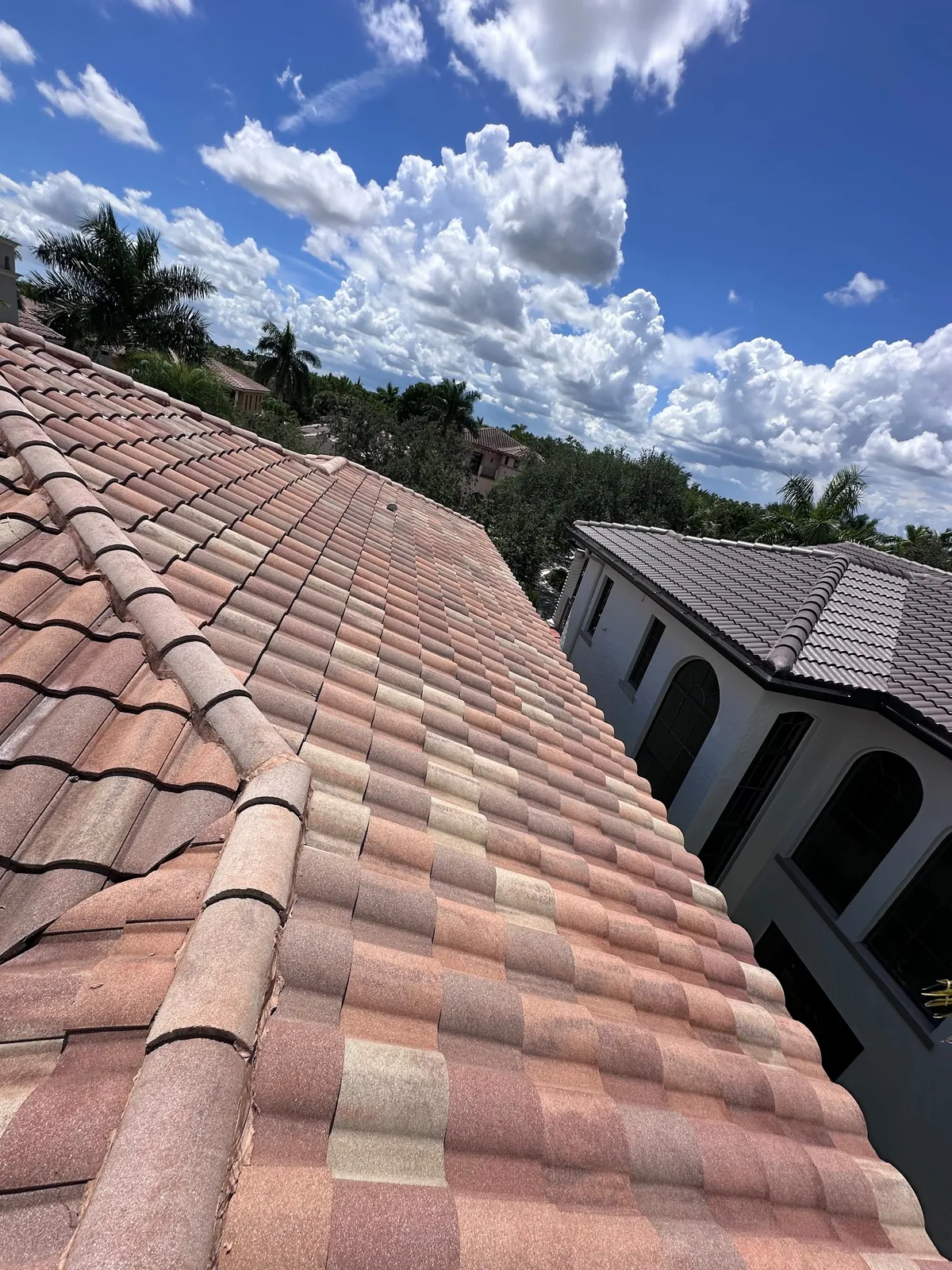
Tile. On tile roofs, a cracked or missing tile exposes the underlayment beneath, which is the real barrier against water. Near the coast, the fasteners holding tile can corrode, and a tile that looks fine may be loose. A tile repair includes checking the underlayment and the fastening in the area as well as the tile itself.
Shingle. Shingles lose their seal and their granules in the sun, and lift in wind. Salt air does not help the nails. Lifted tabs can be resealed or replaced where the rest of the roof is sound.

Fascia, soffit and rafter tails
On older houses, the roof edge tells you a lot. Fascia boards that have softened, paint that blisters along the eave, soffit panels that sag or have dropped away: each points to water getting in at the edge. Behind the fascia, the ends of the rafters can rot too, especially where a gutter has overflowed for years.
The roofer repairs or replaces the damaged fascia and soffit and checks the rafter ends behind them. Where the wood has gone soft, it needs replacing before new roofing is fixed to it. If you hear animals in the roof space, mention it. Removing them is a wildlife professional’s job and comes before the openings are closed.
Mould, smell and slow leaks
A slow leak in an older house rarely stays in one place. Water soaks into the plaster, the lath behind it and the insulation above, and in this humidity mould follows. A musty smell in one room, dark spotting on a ceiling, paint lifting in a closet or a warped ceiling board can all be the roof long before any drip appears.
Mention any of these when you call. The roofer stops the water at the roof. Drying out the ceiling and dealing with mould inside the house is separate work, best done once the leak is fixed, so the same patch does not come back. Keep photographs of what you see inside, both for the roofer and in case you need them for your insurer.
Storm season near the water
Homes close to the Intracoastal and the coast take wind from the water with little to break it. Storm surge and flooding are matters for other trades and your insurer, but the roof takes the wind and the rain.
After a storm, once it is safe:
- Look at the roof from the ground for missing tile or shingle, lifted metal and flashing pulled from walls.
- Check flat sections for standing water and torn membrane, if you can see them.
- Walk the yard for debris from the roof and keep what you find.
- Watch the ceilings for several days.
- Take dated photographs of everything.
Where a storm has opened the roof, the roofer can tarp the damaged area to keep the weather out until the repair is done. Do not go up yourself.
For the insurer
A claim for wind damage is yours to make with your insurer. The roofer is a witness to the roof, not a judge of the claim. What the roofer can give you is a set of photos from up on the roof and a written note of what they found and how they repaired it. Put that with your own photos and the debris you kept. On an older house, the insurer may ask about the roof’s age and previous repairs, so keep any records you have.
Permits and code on older houses
Broward is inside the High-Velocity Hurricane Zone, and roof work must meet the wind rules that came with it. Roof repair in Dania Beach beyond a small fix needs a building permit and an inspection, which the licensed roofer applies for. On an older house, a repair can bring the repaired section up to current code, which may mean new fastening, new underlayment or new decking in that area. Ask the roofer what the code will require on your house before the job starts. If your house is in an older part of town, ask also whether any historic review applies.
Repair or replace
Some older roofs have been patched so often that the next leak is only a matter of time. When that is the case, the roofer will tell you, and show you why. The roofers One Call works with carry out full re-roofs, so if you decide it is time, the same pro can price it. Financing is available for larger roof work; ask about it when you call.
How roof repair in Dania Beach runs through One Call
- You describe the problem, the roof type, the age of the house if you know it, and how close it is to the water.
- You mention any association and whether it needs paperwork.
- One Call matches you with a vetted roofer, licensed and insured for your roof, who works in this part of Broward.
- The roofer inspects, explains what they found, and sets out the repair and the materials.
- You ask what the price covers and agree it before work begins.
- The repair is done, with a permit where needed. If water returns, One Call takes it up with the roofer.
You pay One Call for the job, and One Call pays the roofer, so there is a single point of contact throughout.
One Call arranges the same work in the cities either side, through roof repair in Hollywood and roof repair in Fort Lauderdale.
Questions from Dania Beach
Why does the flashing on my roof keep rusting?
Salt air near the Intracoastal corrodes metal faster. Ask the roofer to use flashing and fasteners suited to coastal exposure, so the repair lasts longer.
My house is old and the roof is flat. Can it be repaired?
Usually. The roofer checks the membrane, seams, drains and the deck beneath. If the deck has rotted, that is repaired first. Roofers in One Call’s network work on flat roofs.
Who repairs the roof on my townhouse?
That depends on your association’s documents. If the roof is yours, One Call matches a roofer and can send the insurance certificate and approval paperwork to the association.
Does roof repair in Dania Beach need a permit?
Anything beyond a small fix does. The licensed roofer applies for it and arranges the inspection, and on an older house the repaired area may need to meet current code.
Have the roof looked at
Tell One Call what is leaking, what kind of roof you have and where the house is. We match you with a vetted, licensed roofer and keep the job on track.